







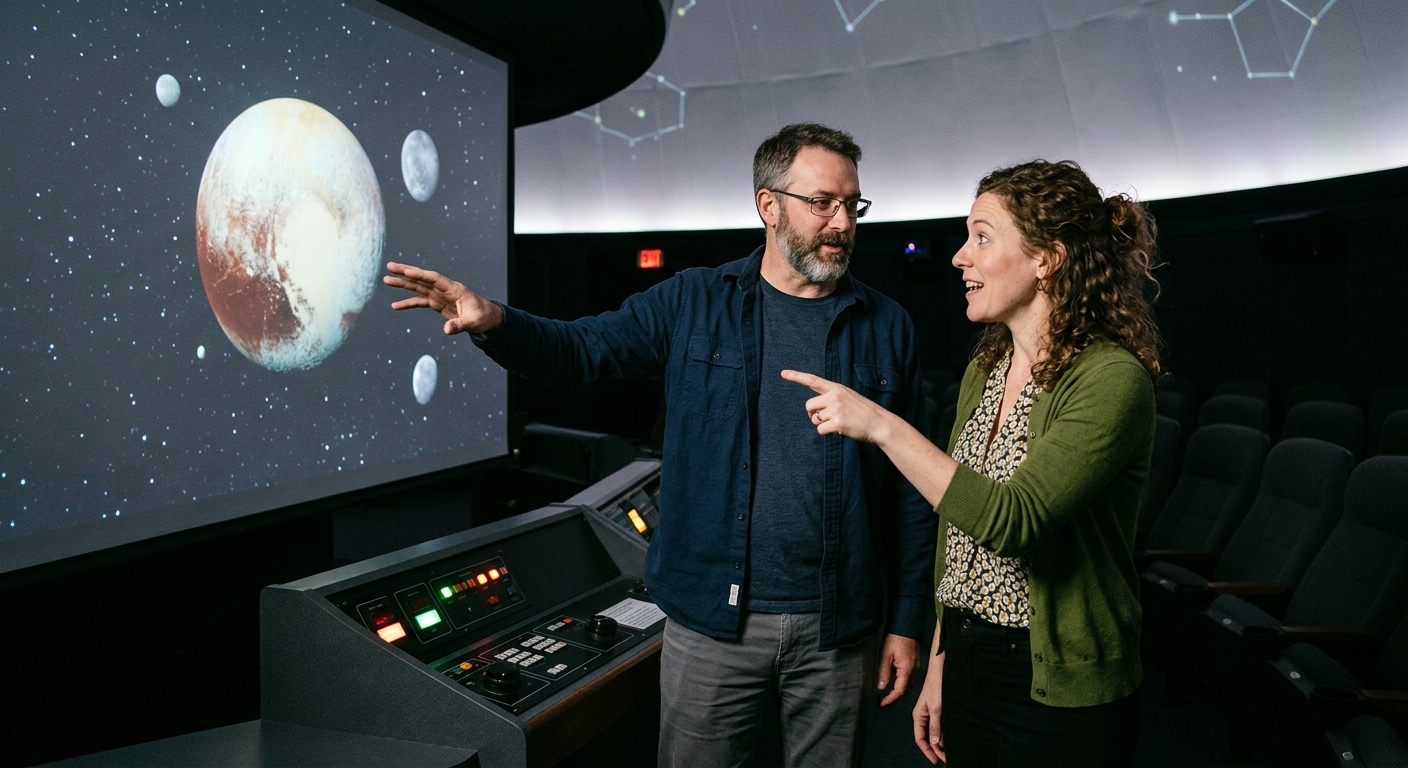
13 May Pluto’s Planetary Status: Science vs. Sentiment
The Resurgence of Pluto’s Planetary Status: A Battle Between Science and Sentiment
The debate over Pluto’s status as a planet captures not only scientists but the general public too. This long-standing controversy, reignited by NASA chief Jared Isaacman’s recent comments, highlights the tangled web of scientific classification and cultural sentiment.
Scientific Criteria vs. Cultural Affection
Pluto once held the title of the ninth planet in our solar system. That was until 2006, when the International Astronomical Union (IAU) rebranded it as a “dwarf planet.” Why? It all comes down to criteria: a planet must orbit the Sun, be nearly spherical, and clear its orbit of other debris. Pluto fits the first two boxes but shares its orbital path with other Kuiper Belt objects, thus the demotion.
The IAU’s decision, grounded in science, met with public outcry—especially among Americans. After all, Clyde Tombaugh, the astronomer who discovered Pluto, was one of their own. For many, the demotion felt like a blow to national pride and scientific heritage.
NASA’s Potential Reconsideration
Recent buzz suggests Pluto’s planetary status might be up for review. Jared Isaacman, NASA’s head honcho, has voiced interest in revisiting the classification. During a US Senate committee session, Isaacman shared that NASA is actively examining “some papers” to reassess the criteria that led to Pluto’s controversial reclassification.
This potential shift reflects a larger trend in scientific discourse: increasingly, rigid classifications are being questioned with fresh data and perspectives. Take the New Horizons spacecraft’s 2015 flyby, for example. It revealed Pluto’s intricate landscape, with towering mountains and sprawling nitrogen-ice glaciers—making us rethink previous assumptions.
The Ongoing Debate
The debate on Pluto underscores the clash between cold, hard science and warm, fuzzy sentiment. Alan Stern, a staunch advocate for Pluto’s planetary status, insists scientific decisions shouldn’t be a popularity contest. “Science isn’t about voting,” Stern declared in 2016. “We don’t vote on the theory of relativity. We don’t vote on evolution.”
“Science isn’t about voting,” Stern remarked in 2016. “We don’t vote on the theory of relativity. We don’t vote on evolution.”
Yet, Pluto’s charm—and the pride of its American discovery—keeps the reclassification debate alive. It’s a perfect example of how scientific stories are often swayed by cultural and political winds.
The Path Forward
As NASA delves into the possibility of reinstating Pluto’s planetary status, the discussion highlights the importance of flexibility in scientific classification systems. This debate is a reminder of how scientific understanding is ever-evolving—and how public perception can shape scientific discourse.
Will Pluto once again be hailed as a planet? That’s still anyone’s guess. But the conversation it sparks continues to captivate scientists and the public alike—bridging empirical evidence with cultural identity.
No Comments