




22 Nov Trump-Endorsed Candidates Achieve 67% Win Rate
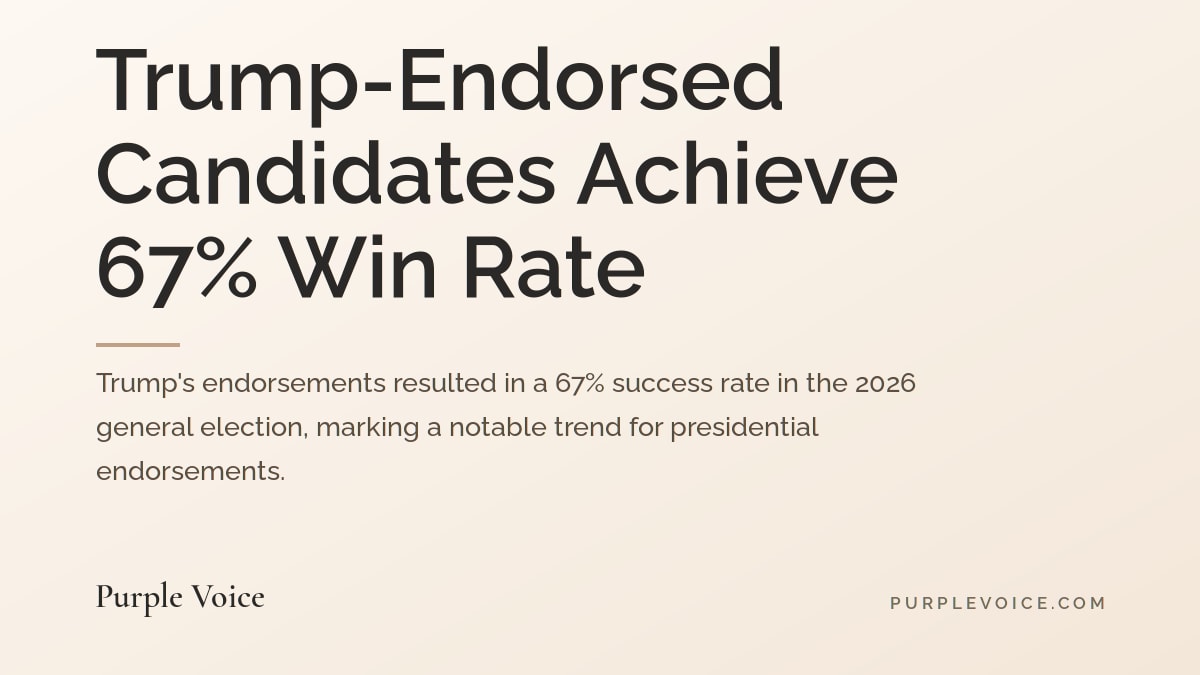
Trump-Endorsed Candidates Achieve 67% Win Rate
Trump-endorsed candidates won 67% of their 2026 general election races so far, according to Ballotpedia. That’s the second-lowest success rate for a president’s endorsements in an even-numbered year since 2018. If you’ve seen the claim that the endorsement machine is unbeatable, the numbers say otherwise.
Key takeaways
- Ballotpedia counted 334 general election endorsements by President Donald Trump, with 219 winners and 108 losers as of November 20.
- Governor races were his weakest category, with 9 of 23 endorsed candidates winning.
- State House endorsements were his strongest, at 13 of 16.
- Seven races, six of them U.S. House contests, were still uncalled when the data was compiled.
What the endorsement numbers actually show
Ballotpedia is a nonpartisan elections research organization. Its count covers general election endorsements only, not primaries. An endorsement is a public statement of support. A win rate tells you how often that support matched the voters’ choice. It doesn’t tell you how much the endorsement helped.
The U.S. House is where most of the action was. Trump endorsed 229 House candidates, and those made up 69% of every general election endorsement Ballotpedia logged for 2026. Of those, 161 won, 62 lost, and six remain uncalled.
The House count is a useful reminder that a big pile of endorsements can hide a lot of variation. A candidate who won a safe district and one who won a close race both count as a win.
Where the endorsements worked and where they didn’t
State House races were the strongest category. Thirteen of 16 endorsed candidates won, an 81% success rate. Governor races were the weakest. Trump endorsed 23 gubernatorial candidates, and nine won, a 39% rate. Other state executive offices came in at 41%, with one race still uncalled.
Senate endorsees fared better than governors, but not by much. Ballotpedia reports that 13 of 26 federal Senate endorsees won, or 50%.
A 67% win rate sounds strong until you remember that a candidate who was going to win anyway still counts as a win.
How 2026 compares with past cycles
Ballotpedia’s comparison runs back to 2018. The lowest even-year rate in that stretch was 59%, recorded in 2018. The highest was 89% in 2024. Counting off-year elections too, the weakest cycle was 2025, when only 43% of Trump-endorsed candidates won general elections.
Ballotpedia says 2026’s 67% is tied with 2019 for the same rate. Those comparisons only hold if the endorsement pool looked similar each year, and Ballotpedia’s data alone can’t confirm that.
Redistricting, the redrawing of congressional maps, adds another layer. NPR reported that in North Carolina, Republican lawmakers redrew districts aiming to gain one U.S. House seat, but instead lost two. NPR’s political science term for that outcome is a “dummymander,” a map that backfires on the party that drew it. Our read is that a map can fail even when a party’s endorsements look strong on paper, and that’s worth keeping in mind whenever someone hands you a single win rate and calls it the whole story.
What to watch as the remaining races are called
Seven races were still open when Ballotpedia published its figures. So the 67% number will move. Six of those are House contests, which means the House success rate could shift by a few points in either direction.
Watch the official vote counts and the calls from major news organizations, then update your own tally. If you want to compare endorsement records across cycles or check a specific candidate’s voting record, the data is public and worth pulling yourself.
Purple Voice tracks roll-call votes, bills, and campaign finance filings from official sources so you can check claims against the record. Learn how the platform works on our about page.
Questions people ask
What is a general election endorsement?
A general election endorsement is a public statement of support for a candidate in the November election, after the primaries. Ballotpedia counts these separately from primary endorsements.
Why are some 2026 races still uncalled?
Some races remain uncalled because the vote count isn’t final or the margin is too close for news organizations to project a winner. As of November 20, Ballotpedia listed seven races in that category, six of them U.S. House races.
Is 67% a low win rate for a president’s endorsements?
It’s the second-lowest even-year rate Ballotpedia has recorded since 2018, and the comparison depends on the year and the offices involved. The lowest even-year rate in that period was 59% in 2018, and the highest was 89% in 2024.
No Comments